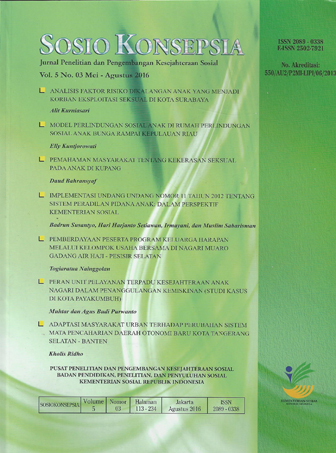
IMPLEMENTASI UNDANG UNDANG NOMOR 11 TAHUN 2012 TENTANG SISTEM PERADILAN PIDANA ANAK: DALAM PERSPEKTIF KEMENTERIAN SOSIAL
Abstract
Diberlakukannya Undang Undang Nomor 11 Tahun 2012 tentang Sistem Peradilan Pidana Anak (SPPA)membutuhkan persiapan yang tidak sederhana. Kesiapan regulasi, lembaga maupun sumberdaya manuasia
pelaksana undang-undang ini menjadi sangat penting dalam menyelesaikan masalah Anak yang Berhadapan
dengan Hukum (ABH). Penelitian ini dilaksanakan menggunakan pendekatan kualitatif. Informan yang
dipilih sesuai dengan kriteria dengan pelaksanaan SPPA. Dengan demikian pemilihan informan dilakukan
secara purposive sampling. Teknik pengumpulan data melalui wawancara dengan pedoman umum,
partisipasi observasi, diskusi kelompok terfokus dan studi kepustakaan/dokumentasi. Artikel ini bertujuan
untuk melihat kesiapan-kesiapan tersebut, yaitu kesiapan regulasi, kelembagaan dan sumberdaya manusia.
Penelitian ini dilaksanakan di empat wilayah tempat yang ada Panti Sosial Marsudi Putra (PSMP) dibawah
Kementerian Sosial yaitu DKI Jakarta, Jawa Tengah, Mataram dan Sulawesi Selatan. Kesiapan regulasi
pada tataran mikro, merupakan hal yang paling urgen untuk segera dipenuhi oleh Kementerian Sosial.
References
Alston, M. & Bowles, W. (2003). Research
for Social Workers: An introduction to
methods. 2nd Edition. Allen & Unwin;
Australia.
Badan Pusat Statistik & Kementerian
Pemberdayaan Perempuan dan
Perlindungan Anak (2011). Profil Anak
Indonesia 2011. Jakarta: Kerjasama
Kementerian Pemberdayaan Perempuan
dan Perlindungan Anak dengan Badan
Pusat Statistik.
Clinard, M. B. , & Meier, R. F. (2001). Sociology
og Deviant Behavior(Fourteenth
Edition ed. ). USA: Wadsworth Cengage
Learning.
Convention On The Right Of The Child (1989)
tentang perlindungan anak, Perserikatan
Bangsa Bangsa.
Cipriani, D. (2009). Children’s Rights and the
minimum age of Criminal Responsibility
a Global Perspektive. Ashgate
Publishing Limited.
Ditjen Pemasyarakatan (2014) Data Anak Yang
Berhadapan Dengan Hukum Tahun
-2013. Jakarta. www. ditjenpas. go.
id.
Depsos. (2001). Intervensi psikososial. Jakarta:
Departemen Sosial.
Detrick, S., Abel, G., Berger, M., Delon, A. ,
& Meek, R. (2008). Violence Against
Children In Coflict With The Law, A
Study on Indicators and Data Collection
in Belgium, England and Wales, France
and the Netherlands. Nederland:
Defence for Children International - The
Netherlands.
Farrington, D. P. (1998). Youth Crime and
antisosial behavior. In A. Campbell,
& S. Muncer, The Sosial Child. UK:
Psychology Press Ltd.
Gerungan, W. A. (1988). Psikologi Sosial.
Bandung: PT Eresco.
Griffiths, C. T. , Dandurand, Y. , & Murdoch,
D. (2007). The Sosial Reintegration
of Offenders And Crime Prevention.
Canada: The International Center for
Criminal Law Reform and Criminal
Justice Policy (ICCLR).
Junus, A. R. (2012). Peran Jaksa Dalam
Menerapkan Konsep Diversi Terhadap
Anak Yang Berhadapan Dengan Hukum
(Tesis). Jakarta: Fakultas Hukum
Universitas Indonesia.
Kurniasari, A. (2009). Profil Pendamping
Dalam Perlindungan Anak Berhadapan
Dengan Hukum. Jakarta: P3KS Press.
LBH-Jakarta. (2012). Situasi Anak Yang
Berhadapan Dengan Hukum Dalam
Proses Hukum Pidana. Jakarta.
Midgley, J. (1995). Sosial Development, The
Developmental Perspektive In Sosial
Welfare. London: SAGE Publications.
Mizrahi, T. , & Davis, L. E. (2008). Encyclopedia
of Sosial Work(20th ed., Vols. Volume
: J-R). NASW Press, OXFORD
University Press.
NASW. (2005). NASW Standards for Sosial
Work Practice in ChildWelfare. NASW.
O’loughlin, M., & O’louhglin, S. (2008).
Transforming Sosial Work Practice,
Sosial Work With Children and Families
(second ed. ). Learning Matters. Ltd.
Pedoman Riyadh. (1990). United Nation
Guidelines for Prevention of Jufenile
Deliquency.
Pusat Data dan Informasi Kesejahteraan Sosial.
(2008). Data Penyandang Masalah
Kesejahteraan Sosial. Jakarta: www.
depsos. go. id.
Republik Indonesia (2012) Undang-Undang No
Tahun 2012 tentang Sistem Peradilan
Pidana Anak.
Republik Indonesia (2014) Undang-Undang
No 35 Tahun 2014 tentang Perubahan
atas Undang-Undang Nomor 23 Tahun
tentang Perlindungan Anak.
Rinita, I. I. (2012). Analisa Yuridis Penerapan
Pemidanaan Edukatif Terhadap Anak
Sebagai Pelaku Tindak Pidana (Tesis).
Jakarta: Fakultas Hukum.
Salkind, (2006), Encyclopedia of Human
Development.
SKB (2009) Surat Keputusan Bersama tentang
Penanganan Anak Yang Berhadapan
Dengan Hukum, Indonesia.
Setyobudi (2012), Pembinaan Anak Pidana
Di Lembaga Pemasyarakatan Anak
Tangerang, TesisFakultas Hukum
Universitas Indonesia.
Soekanto, S. (1993). Sosiologi Suatu Pengantar
(Keempat ed.). Jakarta: Rajawali Pers,
PT. Raja Grafindo Persada.
Sutarso. (2005). Praktek Pekerjaan Sosial
dalam Pembangunan Masyarakat.
(C. Jusuf, Ed.) Jakarta: Balatbangsos
Depsos RI.
Shireman, J. (2003). Critical Issues in
Child Welfare. New York: Columbia
University Press.
Smith, D. (2005). Probation And Sosial Work.
British Journal Of Sosial Work, 35, 621-637.
Sulhin. (2011). Filsafat (Sistem)
Pemasyarakatan.
Ward, T. , & Birgden, A. (2007). Human rights
and correctional clinical practice.
Elsevier, 12 (Aggresion and Violent
Behavior), 628-643.
Downloads
Published
Issue
Section
License
Copyright (c) 2016 Badrun Susantyo, Hari Harjanto Setiawan, - - Irmayani, Muslim Sabarisman

This work is licensed under a Creative Commons Attribution-NonCommercial-ShareAlike 4.0 International License.
Policy for Journals that offer open acces
Authors who publish with this journal agree to the following terms:
- Authors retain copyright and grant the journal right of first publication with the work simultaneously licensed under a Creative Commons Attribution-NonCommercial-ShareAlike 4.0 International License that allows others to share the work with an acknowledgement of the work's authorship and initial publication in this journal
- Authors are able to enter into separate, additional contractual arrangements for the non-exclusive distribution of the journal's published version of the work (e.g., post it to an institutional repository or publish it in a book), with an acknowledgement of its initial publication in this journal
- Authors are permitted and encouraged to post their work online (e.g., in institutional repositories or on their website) prior to and during the submission process, as it can lead to productive exchanges, as well as earlier and greater citation of published work (See The Effect of Open Access).